



It’s time to walk the walk. Isometric is setting a net zero target. We will decarbonize as much as we can and offset the remainder with high-quality carbon removal credits.
We’re at the start of this journey—the first in a series sharing what we learn along the way.
Why?
Isometric’s mission is to reverse climate change. Cutting emissions and paying others to remove them are both essential to achieve that mission. The buyers we work for have their own climate targets and rely on our certification to meet them in a credible way.
We also have a carbon footprint, so it seems only right that we should go on the same journey as our customers. That footprint is relatively small: our products, the Isometric Registry and Certify, are digital and we have fewer than 100 employees. But we should still try to cut our emissions and remove any unavoidable emissions from the atmosphere.
The impact from Isometric alone doing this is small. But that logic can’t be an excuse for inaction. So this is primarily about living up to our values, but with the hope of inspiring others to do the same and multiplying our impact.
How?
At a high level, it's clear what we need to do: set a target year to become net zero, calculate last year's carbon footprint, find ways to reduce emissions, and buy high-quality carbon removal credits.
Simple in theory. In practice, each step involves decisions, new processes, and input from other organizations. We’ll start with setting a target. There are two decisions we need to make first:
- Ambition: how soon should we hit our target?
- Validation: should our target be validated by a third-party, such as the Science Based Targets Initiative (SBTi)?
Ambition
We haven’t calculated our footprint yet, but as a very rough estimate I assume it will be less than 1,000 tonnes—fewer than 100 people, at under 10 tonnes each. So, we could achieve net zero this year by offsetting all of our emissions with a $200,000 budget (1,000 * $200/t). It's not unthinkable, but that's a significant amount for a company of our size to spend. However, if the climate change problem had a cheap solution it would have been solved already. So, I think we should set a target that aligns with our most ambitious customers: 2030.
Validation
Instinctively, I want this target validated by the SBTi. I spent many hours in 2025 reading their draft Corporate Net-Zero Standard 2.0, and then their revised draft. I also had hundreds of conversations with SBTi members. But it’s not just sunk cost bias that makes me want to do it: I want to learn for myself what it means to set an SBTi-validated target. I’ve shared feedback with SBTi on their consultation drafts—it would be a lot more impactful if I did so based on lived experience.
So, I signed up to SBTi.
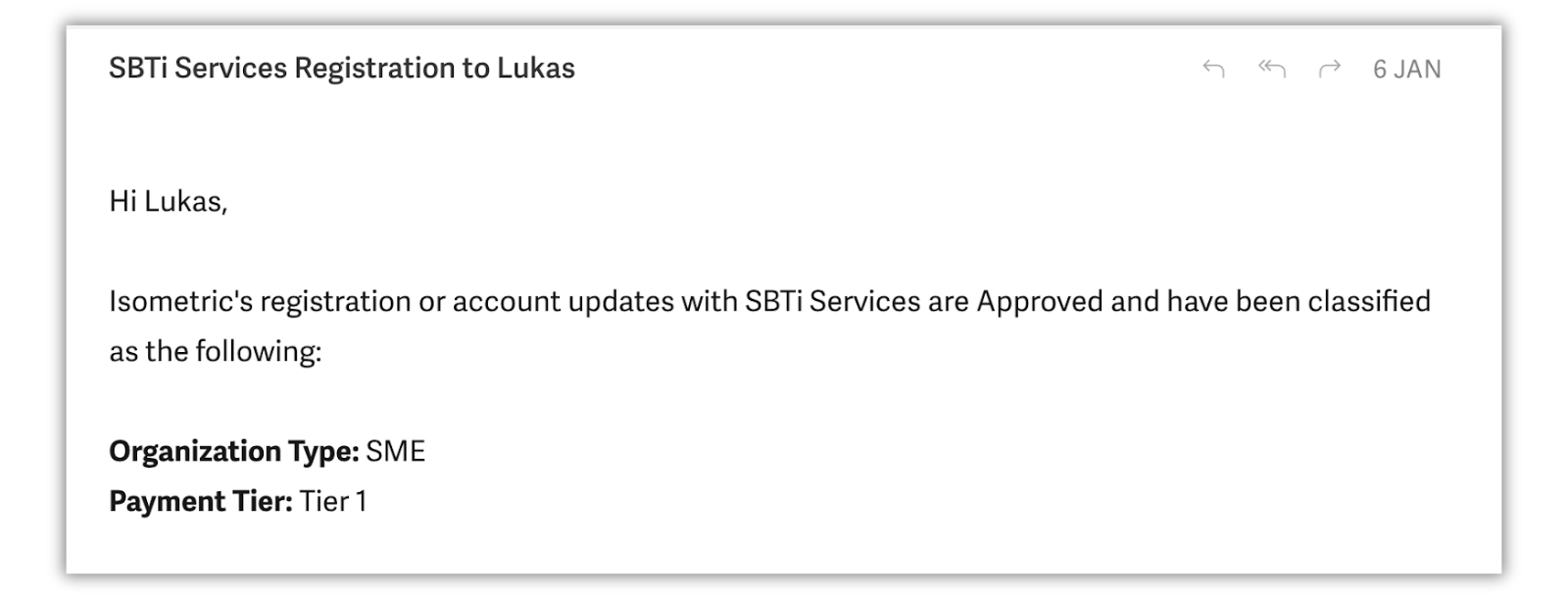
But then I started hitting some challenges.
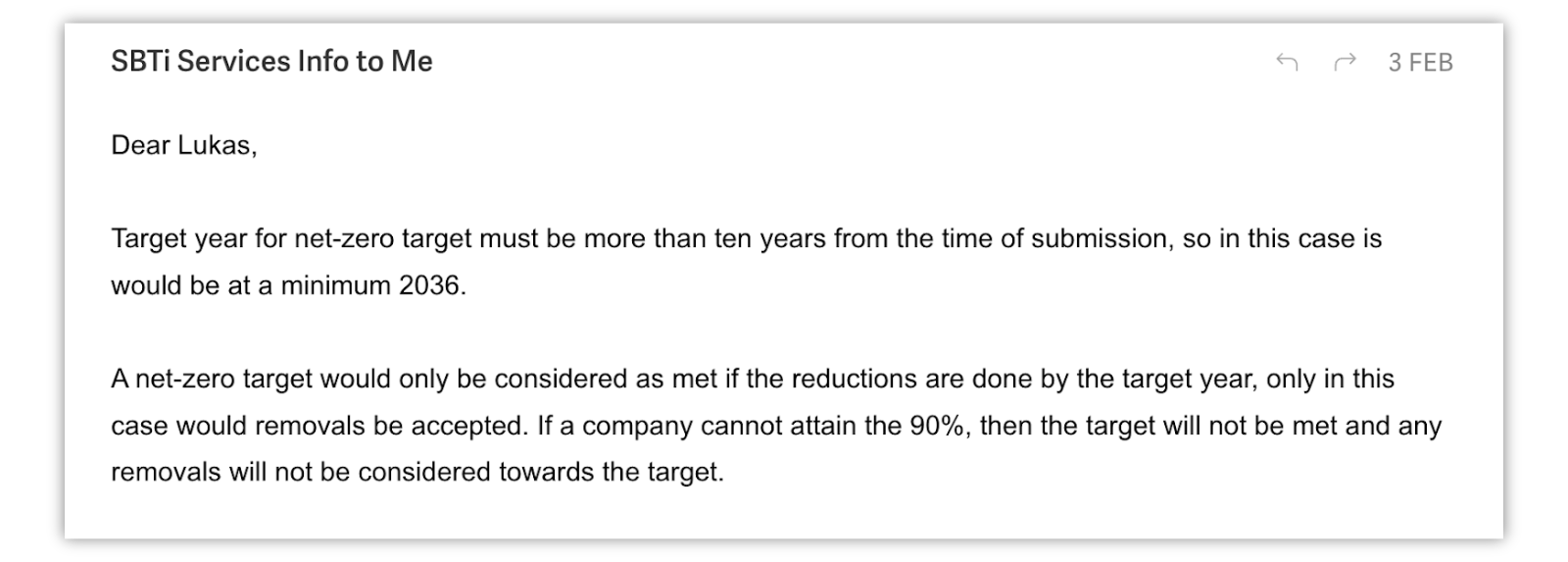
As a fast-growing services company, setting an absolute reduction target does not make much sense. The more people we hire, the bigger our emissions profile. Even with ambitious reductions in per-head emissions, we would have no chance of achieving a 90% reduction in absolute emissions. This seems to be addressed in the latest SBTi draft, however, guidance on this isn’t available until that draft is finalized.

As for our 2030 target, that’s simply not possible under v1 of SBTi’s Standard, because it’s less than five years away. A gap for incentivizing ambition, which will hopefully be addressed in future. Additionally, while under v2 there is explicit recognition for the benefit of funding carbon removal now, under v1 early action on carbon removal doesn’t count until your net zero year.
What's next?
A more complicated start than expected. But we can keep moving forward. I’ll draft our 2030 target in pencil for now. If we do align with SBTi it seems we will need to formally set it for 2035 and have an interim target in 2030. That doesn’t stop us aiming to achieve net zero in 2030 anyway. And under v2 we should get recognition for the action we take on offsetting with removals.
While we won’t be moving forward with SBTi until v2 is finalized, that doesn’t stop us making progress in the meantime.
Next up: calculating our 2025 footprint, which will serve as our baseline year. We'll share what we learn in the next post. Get in touch if you're on a similar journey.
