




Carbon dioxide removal (CDR) is a global public good, but without governments stepping in and creating demand we will not do enough of it. Economists have long understood this, and the solution is clear: governments must recognize that removing carbon from the atmosphere is worth paying for, so that markets deliver the removals we need to get to net zero. This is where integration with an Emissions Trading System (ETS) comes in.
The European Union’s ETS is arguably the most sophisticated, ambitious, and durable climate policy the world has so far seen. Launched in 2005, it had teething problems at first, but through years of painstaking improvement it has emerged as a policy that delivers. The market is now worth more than €800bn a year. It is powerfully but efficiently reducing emissions in Europe, and via its carbon border adjustment mechanism it is driving the spread of carbon pricing across the world.
The EU Commission is rightly cautious about changes to the ETS, and prioritizes careful, gradual reform over sudden or dramatic change. These are smart people balancing competing interest groups, and ultimately delivering real climate impact.
On July 17 this year, the Commission will publish its proposals for the initial phase of CDR integration into the ETS. This is a huge moment for the sector and a subject close to my heart. Before I joined Isometric, I led the UK Government team working on CDR integration into the UK ETS. I know firsthand the policy tradeoffs involved. When the proposal lands, there are three main things I’ll be hoping to see:
1. Confirm integration will go ahead as soon as possible
First, the Commission should confirm it is integrating CDR in the next phase of the ETS, beginning in 2031. The removals industry needs this. No other policy has the same potential to scale CDR to levels needed for net zero in 2050. But the ETS also needs removals. Integrating CDR gives emitters a way to manage residual emissions while staying competitive. There is no viable long-run future for the ETS without CDR, with it, the ETS can guide our economies to net zero in an economically efficient, and therefore more politically sustainable, way.
2. Purchase net-zero consistent quantities of CDR
Second, the Commission should set out the quantities of removals it will bring into the ETS. The exact mechanism is yet to be confirmed, but most likely it will be so-called indirect integration, where the Commission purchases CDR credits using ETS revenues, and then creates an equivalent number of ETS allowances. The crucial question is how much CDR it is going to buy.
The Commission's own previous analysis suggests the EU will need 75 million tonnes (Mt) of permanent CDR per year by 2040 to stay on track for net zero in 2050. Others have put this figure higher. Last year, Carbon Gap estimated 193 Mt, and a recent paper in Nature Communications found 131 Mt. By my calculation, the UK’s official Climate Change Committee recommendation for the UK is equivalent to around 130 Mt for the EU.*
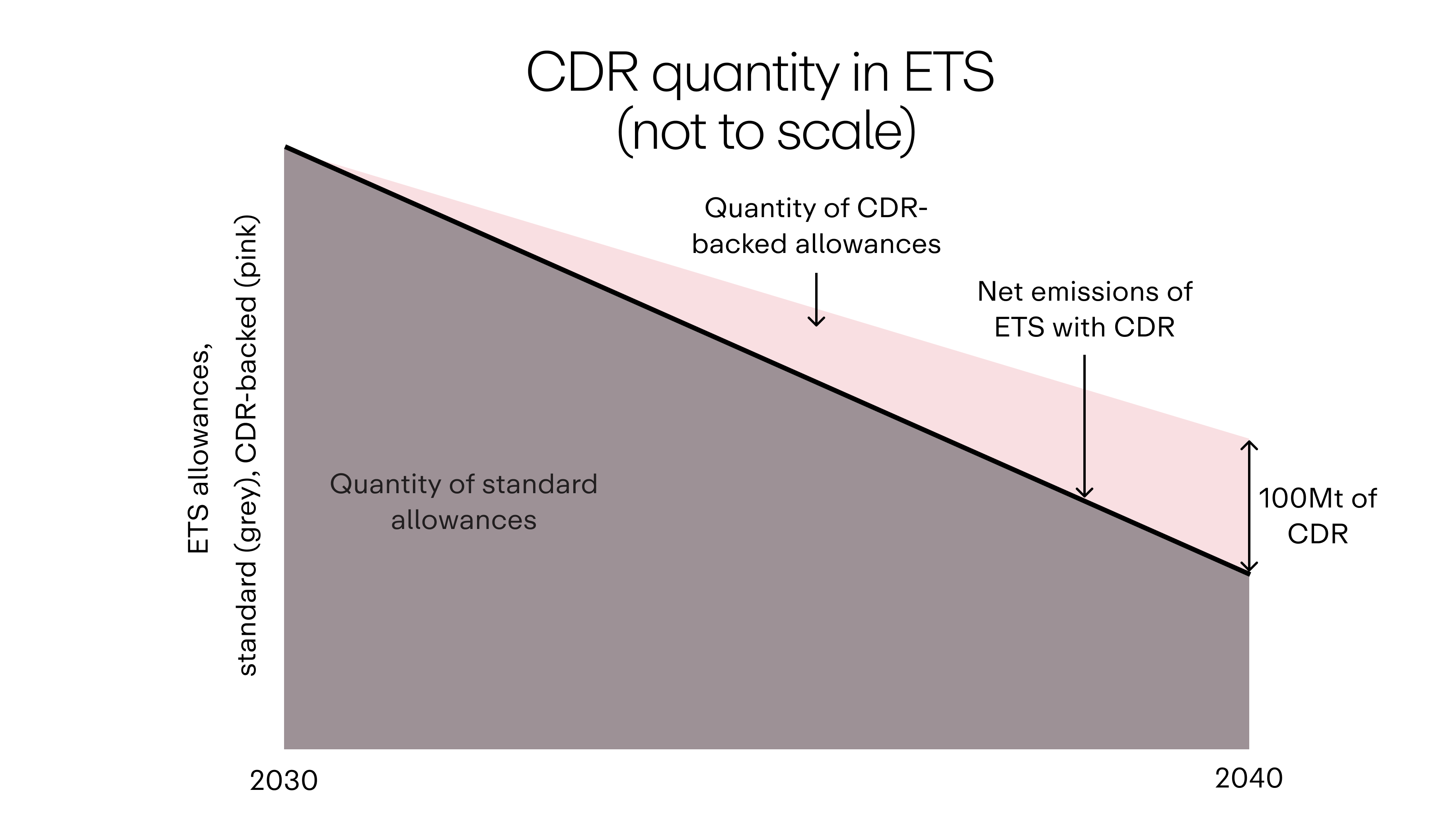
Not all of Europe’s permanent CDR needs to come through the ETS, but most of it will: the anticipated combination of ETS 1 and ETS 2 is set to be around 75% of emissions, and no credible policies yet exist for the remainder. If we take the median estimate from the four above, and assume 75% must be delivered by the ETS, that gives us a quantity of CDR in the ETS of 100 Mt in 2040. This, or something near it, should be the target.
The 2040 target will then anchor a steady increase over the years 2031-40. A linear trajectory is shown in the chart below as a simple example of the kind of quantities the Commission could propose. We should be honest that this will cost meaningful amounts of public money, but at levels manageable within current ETS revenues. EU Member States, which control most ETS revenues, will ultimately have to decide how much CDR they want to buy.
3. Tech neutral, not picking winners
Third, the Commission should avoid picking winners and take a tech neutral approach. Tech neutrality has been a foundational principle in the ETS from the beginning: the system does not care how or why you are emitting; all that matters is your impact on the atmosphere. The same principle should apply to removals and every credible method of permanently removing carbon should be treated equally.
How do we define what works? Isometric was founded in 2022 essentially to answer this question. Since then there has been huge progress across the industry, most recently culminating in the EU moving to regulate the market with its Carbon Removals and Carbon Farming regulation (CRCF). It already tells us what the EU sees as viable permanent CDR in Europe, with methodologies for direct air capture, bioenergy with carbon capture and storage, and biochar carbon removal.
The Commission should use the CRCF as the basis for ETS integration, with tech-neutral requirements layered on top if it has additional policy objectives. These could include:
- If the Commission wants to increase the permanence of carbon storage, they could extend requirements from 200 to 1,000 years. For biochar, this would mean requiring projects to use the random reflectance part of the CRCF methodology, which could be combined with requiring an H/Corg ratio less than 0.5.
- If the Commission wants to take an ultra-conservative approach, and wait for additional scientific evidence on top of the considerable base that already exists on biochar, it could set a temporary cap on the share of biochar in its purchases. The cap could be set at 30%.**
- If the Commission wants to maximize policy consistency across CRCF and ETS, it could rely on the CRCF review process to incorporate new scientific evidence into CDR methodologies, and layer no additional requirements on top of CRCF. This would be the simplest policy design.
Adopting one or several of these approaches would provide a clear set of eligibility conditions for all CRCF pathways. All other existing rules should be applied in a tech neutral way, including those on biomass—there is no reason to treat biomass in BECCS differently to biomass in biochar. The Commission should also continue the ongoing process of developing CRCF methodologies for other credible pathways such as enhanced rock weathering and surficial mineralization.
CDR needs the ETS and the ETS needs CDR. The decisions taken over the coming months will be central to driving long-term demand for carbon removal. A clear policy package on July 15, with an ambitious and tech neutral framework, would tell the market that Europe is serious about the removals it needs.
* The UK Climate Change Committee recommends 21 Mt of permanent CDR for the UK in 2040. Given the EU is ~6 times bigger than the UK (by either GDP or population), this is equivalent to an EU figure of 130 Mt in 2040 (rounding to 2 significant figures).
** The 30% biochar cap number could be refined further, but this is my starting point because: (1) it leaves the majority (70%) of the market to alternative CDR pathways while there is any uncertainty in the eyes of policy makers; (2) it is significantly less than half (23-30%) of the estimates of maximum biochar supply, such those summarised in Chiaramonti et al (2024), suggesting would indeed cap supply.
