



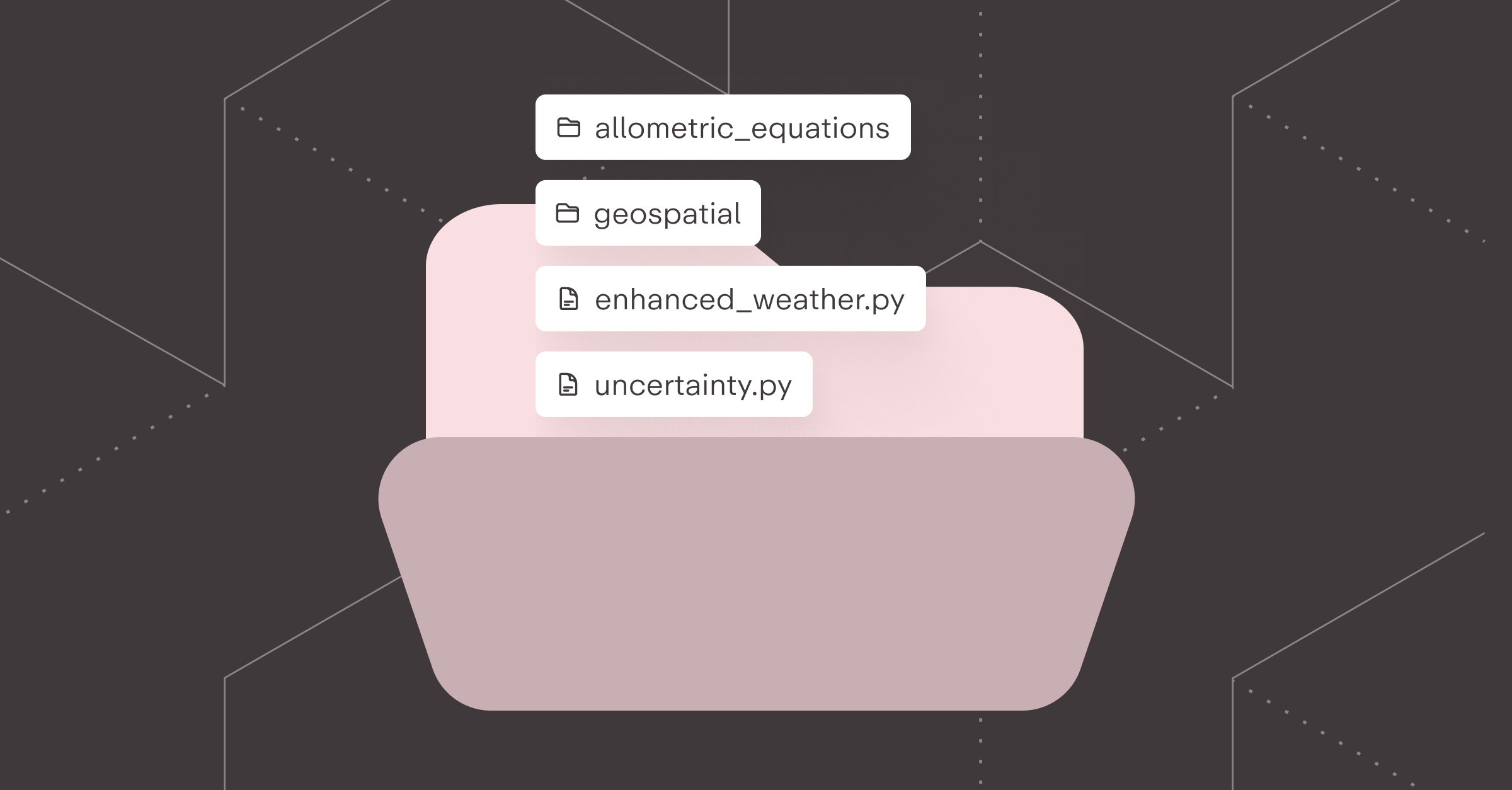
Isometric has open-sourced its Calculation Library, a shared set of best-practice code for the complex calculations behind carbon removal. Suppliers can now access and use the same tested methods Isometric applies, rather than developing an approach from scratch. Verifiers benefit too, reviewing calculations they already know instead of assessing a new approach for every project. This means certification that's faster and simpler for everyone involved.
What's in the library
Quantifying carbon removal can be complex. For pathways like Enhanced Weathering and Biosphere, the underlying data is rich and varied, drawing on real-world measurements, earth observations, and more. With no single agreed way to handle it, suppliers have developed hundreds of different approaches.
The Calculation Library sets out the tried and tested methods Isometric has developed over dozens of verifications. Isometric is now making them openly available so the whole field can work from the same methods. Inside, suppliers will find the core building blocks of a removal calculation: the equations that turn measurements into a removal figure, the statistical tests that check the underlying data, and the code Isometric uses to quantify uncertainty.
Simpler for suppliers
Instead of developing their own calculation frameworks from scratch, suppliers can start from methods Isometric has already developed and tested. That saves time they can put back into their projects. Using the library is optional. Suppliers remain free to use their own methods, but now they can draw on Isometric's too.
Tamara Michaelis, ERW & MRV Scientist at ZeroEx, said: “Enhanced weathering has some of the most complex MRV in carbon removal, and by open-sourcing the CDR calculation methods, Isometric is increasing transparency across the field. The Calculation Library is an important step towards standardizing quantification approaches and statistical checks, which will benefit all project developers.”
Faster for verifiers
When suppliers build on the same methods, verifiers no longer have to work through an entirely new quantification approach for every project. Reviewing proven methods, rather than scrutinizing bespoke calculations from scratch each time, shortens the path from submission to issued certificate, so suppliers can deliver to buyers sooner.
Lily Schacht, Director of Science at 350Solutions, said: “The Calculation Library makes verification faster by reducing the amount of unique code we need to review for each GHG statement and decreasing the likelihood of finding issues in the calculations. Instead of writing bespoke code, suppliers can focus on ensuring that the input data is high quality and the assumptions underlying the calculation approach are appropriate for the project. This results in fewer iterations on the GHG statement once verification begins.”
The Calculation Library is available now on GitHub and the Python Package Index (PyPI). It currently covers the Enhanced Weathering and Biosphere pathways, with plans to expand it to more pathways and to cross-cutting requirements like sensitivity analysis.
